Artificial intelligence has rapidly reshaped how visual content is created, edited, and consumed. Among the most compelling developments are lip sync AI and image to video technologies—two innovations that, when combined, are redefining digital storytelling, marketing, entertainment, and communication. Their intersection marks a significant step toward more realistic, accessible, and scalable video generation, blurring the line between static imagery and dynamic human expression.
Understanding Lip Sync AI
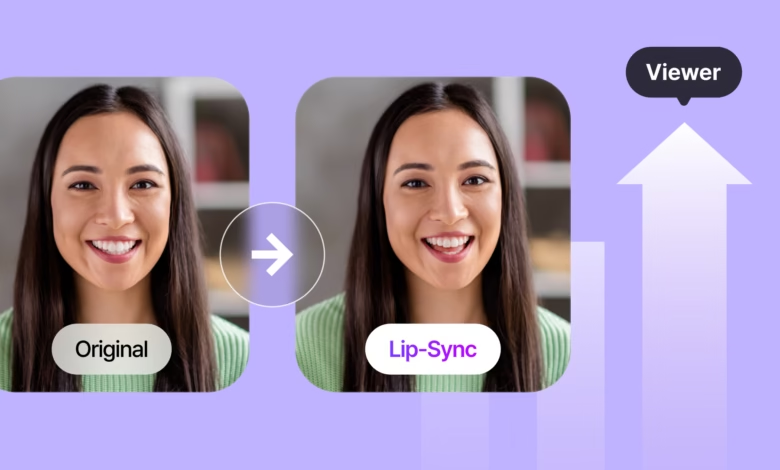
Lip sync AI focuses on synchronizing mouth movements in a visual subject with a given audio track, typically speech. By analyzing phonemes—the distinct units of sound in spoken language—the AI predicts and animates corresponding lip shapes and facial movements. Modern systems go beyond simple mouth motion, incorporating subtle facial cues such as jaw movement, cheek tension, and even micro-expressions.
This technology has evolved from early, often uncanny results to highly realistic outputs capable of matching different languages, accents, and speaking styles. A lip sync AI is now widely used in dubbing, virtual avatars, gaming, accessibility tools, and customer support interfaces. Its core value lies in making speech visually believable, even when the speaker never recorded a video.
What Is Image to Video Technology?
Image to video AI transforms a still image into a moving video sequence. Using deep learning models trained on vast datasets of human motion and facial dynamics, these systems can animate a single photo—adding head movements, blinking, breathing, and environmental motion. Some tools can also extrapolate full-body movement from limited visual input.
At its heart, image to video technology solves a long-standing creative challenge: producing engaging video content without expensive filming, actors, or equipment. It enables creators to generate motion from static assets, opening the door to new workflows in media production, education, and design.
Where Lip Sync AI Meets Image to Video
The true breakthrough occurs when lip sync AI is integrated into image to video pipelines. In this combined approach, a still image of a person can be animated into a speaking, expressive video driven by an audio track. The image provides the visual identity, the image to video model supplies natural motion, and the lip sync AI ensures accurate and convincing speech alignment.
This convergence allows for the creation of “talking head” videos from a single photograph and a voice recording. The result is content that feels personal and lifelike, yet can be produced in minutes rather than days.
Key Use Cases and Applications
One of the most prominent applications is in digital marketing and advertising. Brands can create localized video messages using the same visual asset, swapping out audio for different languages while maintaining accurate lip synchronization. This significantly reduces production costs while increasing personalization.
In education and e-learning, instructors can transform lecture notes or scripts into video lessons using a single portrait. Historical figures, scientists, or fictional characters can be brought to life, enhancing engagement and retention.
Customer support and virtual assistants also benefit from this intersection. Instead of text-based chatbots, companies can deploy animated, speaking avatars that feel more human and approachable, improving user experience.
In entertainment and content creation, independent creators can produce character-driven videos without actors or studios. This democratizes storytelling, allowing small teams or individuals to compete with larger production houses.
Technical Synergy Behind the Scenes
From a technical perspective, combining these technologies is complex image to video AI models must preserve identity consistency while generating motion, and lip sync AI must adapt to the generated facial structure and movement. Timing is critical: audio-driven lip movements must align seamlessly with head motion, eye blinks, and expressions to avoid uncanny results.
Recent advances in diffusion models, generative adversarial networks (GANs), and transformer-based architectures have significantly improved this alignment. Multimodal training—where models learn from audio, video, and images simultaneously—has been particularly important in achieving realistic outcomes.
Ethical and Social Considerations
As with many generative AI technologies, the intersection of lip sync AI and image to video raises ethical concerns. The ability to create realistic speaking videos from a single image introduces risks related to deepfakes, misinformation, and identity misuse.
Responsible deployment requires clear consent mechanisms, watermarking, detection tools, and transparency around AI-generated content. Many developers are actively working on safeguards to ensure the technology is used for creative and constructive purposes rather than deception.
The Future of AI-Generated Video
Looking ahead, this intersection is likely to become a foundational layer of digital communication. As realism improves and barriers to use continue to fall, AI-generated video may become as common as text or images are today. Real-time generation, emotional expressiveness, and full-body animation are already on the horizon.
Rather than replacing human creativity, the fusion of lip sync AI and image to video capabilities enhances it—providing new tools to tell stories, share knowledge, and connect across languages and cultures. The challenge and opportunity lie in guiding this powerful technology toward ethical, imaginative, and meaningful applications.